
Even though I've taken an
entire class on Arthurian myth before, I can never get enough of the world of
King Arthur and his knights, so I couldn't resist picking this unit. Just reading through the first half I was treated to some
cool stories. You have the well-known stories that many people are familiar
with in "The Drawing
of the Sword" and "The Sword
Excalibur," but there's also some less familiar ones
as well. I found "The Questing Beast" interesting since it features a
knight associated with a certain spring, a story element that is also present
in Chrétien de
Troyes's "The Knight with the Lion," which I read in my Arthurian
class. This is a good example of how certain story elements in one Arthurian myth had a tendency to be duplicated in other stories within the genre.
"The Passing of Merlin" was one of my favorite stories in the first half since it's a tale with which I'm less familiar. It's kind of hard to believe how even the wisest of men in Merlin can get taken in by amorous feelings to the point that he submits himself fully to such feelings knowing that they will be his downfall. It's a sad story, but a good portrayal of how emotions can render even the most wise and knowledgeable of people unable to do act in a rational way.
"King Arthur and Morgan Le Fay" was a tale which I was mostly familiar, but the last part of the story in which Arthur forces his own adviser to put on the mantle he received from Morgan was new to me. I found this story a little shocking since Arthur isn't usually portrayed as being so harsh and demanding in the stories I've read (he's either a perfect warrior king or a sleepy ruler whose past his prime in the tales I've covered). I felt bad for the Lady of the Lake who gets burned alive due to Arthur's uncompromising demand for her to basically test the safety of the garment for him.
The stories in the second half that encompass the quest for the Holy Grail are even more compelling than the first half stories. I really liked how characters are given their own story arcs that interweave and come together in a manner similar to what you see in modern novels. In particular I liked the arc of Lancelot. The tale of Lancelot's affair with Guinevere is pretty well known, as is the tragic manner in which it ends, but I like how Lancelot's grail quest emphasizes the heavy toll Lancelot's adultery has taken on his own soul. You really get the feeling in stories like "Sir Lancelot's Vision" and "Sir Lancelot and the Five Hundred Knights" that Lancelot is a man weighed down by guilt and regret. His character stands in sharp contrast to that of Galahad, who is portrayed in every story to be the ideal knight. Coming from my modern perspective that likes flawed, heavily conflicted characters, I found Lancelot's character to be the more compelling of the two.
One of the most intriguing stories to me of this entire unit was "Sir Galahad and the Grail." What made this story so unique to me was how the three grail knights are portrayed in the story. The way they heal a crippled man and then are summarily persecuted by the king of Sarras immediately calls to mind the works and trials of the apostles. While many Arthurian stories portray extremely devout and righteous knights, this is the first narrative I read where it seems like the three men have transcended the role of mere knights and become apostle-like figures.
One of the most intriguing stories to me of this entire unit was "Sir Galahad and the Grail." What made this story so unique to me was how the three grail knights are portrayed in the story. The way they heal a crippled man and then are summarily persecuted by the king of Sarras immediately calls to mind the works and trials of the apostles. While many Arthurian stories portray extremely devout and righteous knights, this is the first narrative I read where it seems like the three men have transcended the role of mere knights and become apostle-like figures.
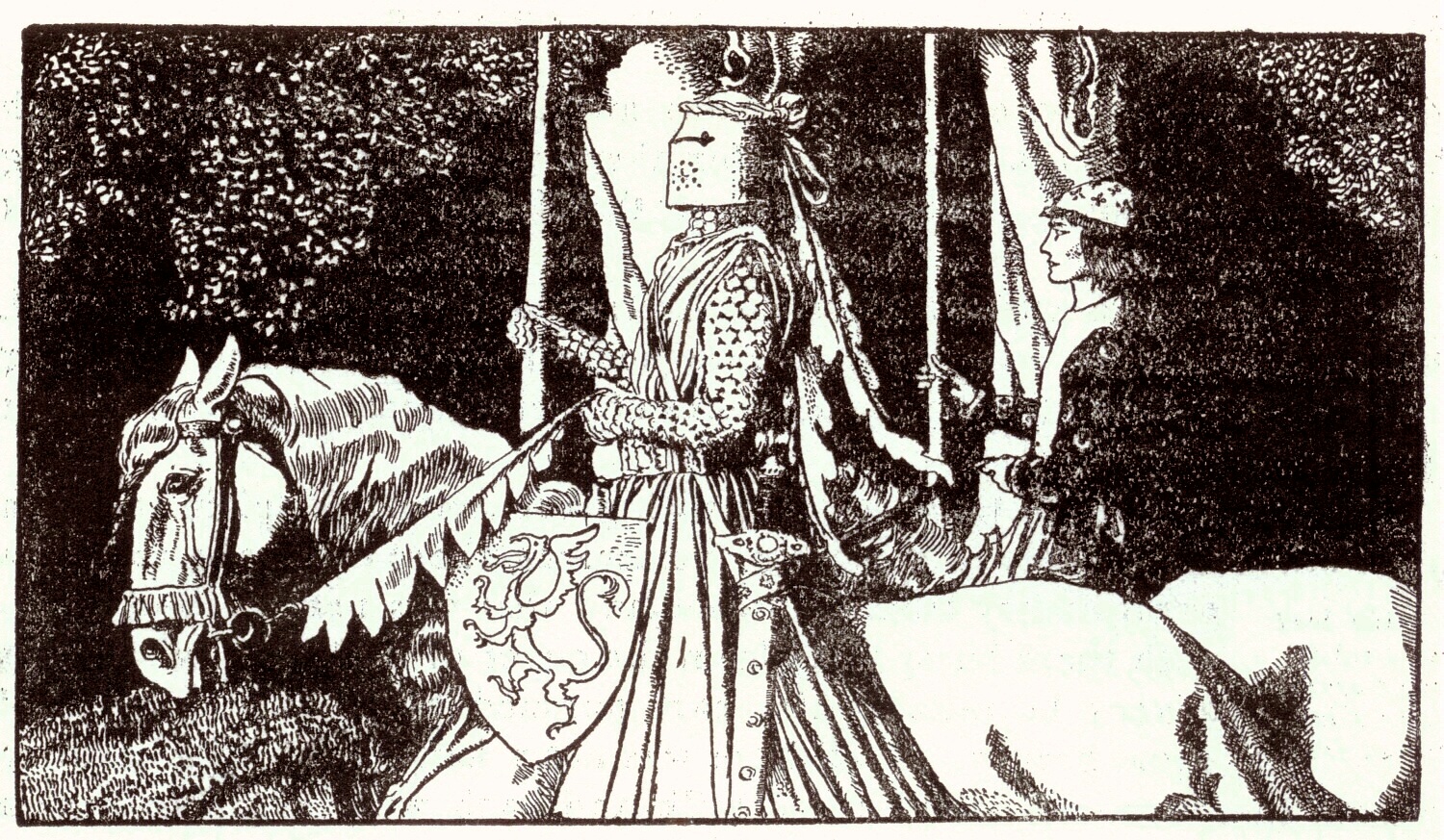 |
| Sorry, Gawain, you can only be the perfect knight in so many stories before you're arbitrarily labeled as more sinful than Lancelot and sent back to Camelot grail-less (1903 Illustration of Gawain by Howard Pyle from The Story of King Arthur and his Knights from Wikipedia) |

No comments:
Post a Comment