Friday, October 31, 2014

Week 11 Essay: Role Modelling in the King Arthur Unit

Negative and Positive Role Modelling in the King Arthur Unit

Historically knights were likely far from the most ideal of people. Such men were, after all, warriors trained to excel in combat and a code like chivalry—at least as it is conceived in modern times—was more likely to be an ideal followed in literature than in reality. Nevertheless, fiction as it was preferred in medieval times was more didactic than focused on the accurate representation of reality. As a result, Arthurian romances give us mostly positive role models in the form of righteous knights like Galahad. At the same time there are also more negative figures who, while not necessarily being wholly immoral, struggle with the sins they have committed  in the past, as is the case with Lancelot.

Galahad is throughout the unit portrayed as being the absolutely ideal knight. He makes no moral mistakes throughout the grail quest arc, and is even able to prevail in combat over the likes of Percival and his own father Lancelot. This is no small victory, and it is indicative of Galahad’s character since I have found that in most cases in Arthurian mythology, the better person also inevitably ends up becoming the best warrior. In addition, Galahad is awarded special equipment during the grail quest. He is given a shield in “Sir Galahad and the White Knight” that is said to only be able to worn by the worthiest knight in the world. Later Galahad proves able to draw a magical sword from a scabbard where his fellow good knights Percival and Bors could not. Finally Galahad is granted the honor of having his soul taken directly to heaven by some angels.  In this particular story arc, Galahad is shown to be the greatest of all knights, someone who’s humble, courteous, and thoroughly devoted to God. He thus also serves as the greatest role model in this particular series of stories.

Although the father of Galahad, Lancelot does not share his son’s near perfection as a person. Lancelot is, of course, that famous knight known for his passionate affair with Guinevere. Although the two often seemed to be portrayed sympathetically in many versions of the tale, in the grail quest Lancelot’s adulterous relationship becomes an obstacle to Lancelot’s quest for the grail. Lancelot is a figure who desires to do good and indeed comports himself very well throughout his grail quest, but because of his past sin that he will inevitably return to later, he cannot overcome the guilt that haunts him on his adventure. “Sir Lancelot and the Five Hundred Knights” is a particularly compelling story that serves thoroughly expose to Lancelot his earthly, sinful condition. Although the sins of Lancelot’s past make him a good example of a negative figure whose example readers should not follow, he also was probably a very relatable figure whose repentant attitude throughout the grail quest would show people who are wrestling with past sins that they need to be suitably contrite for what they have done.


This unit features a lot of knights in the story, most of which are on the whole positive figures. However, because of the successes he has on his quest and the great death that he is granted in the end, Galahad stands above the rest as the best role model that medieval readers would have looked to in order to learn how to conduct themselves.  On the other end of the spectrum, the sinful and guilty Lancelot would serve as a negative role model in some ways, but also as an example of a person who has a soft conscious and desire for penance.  

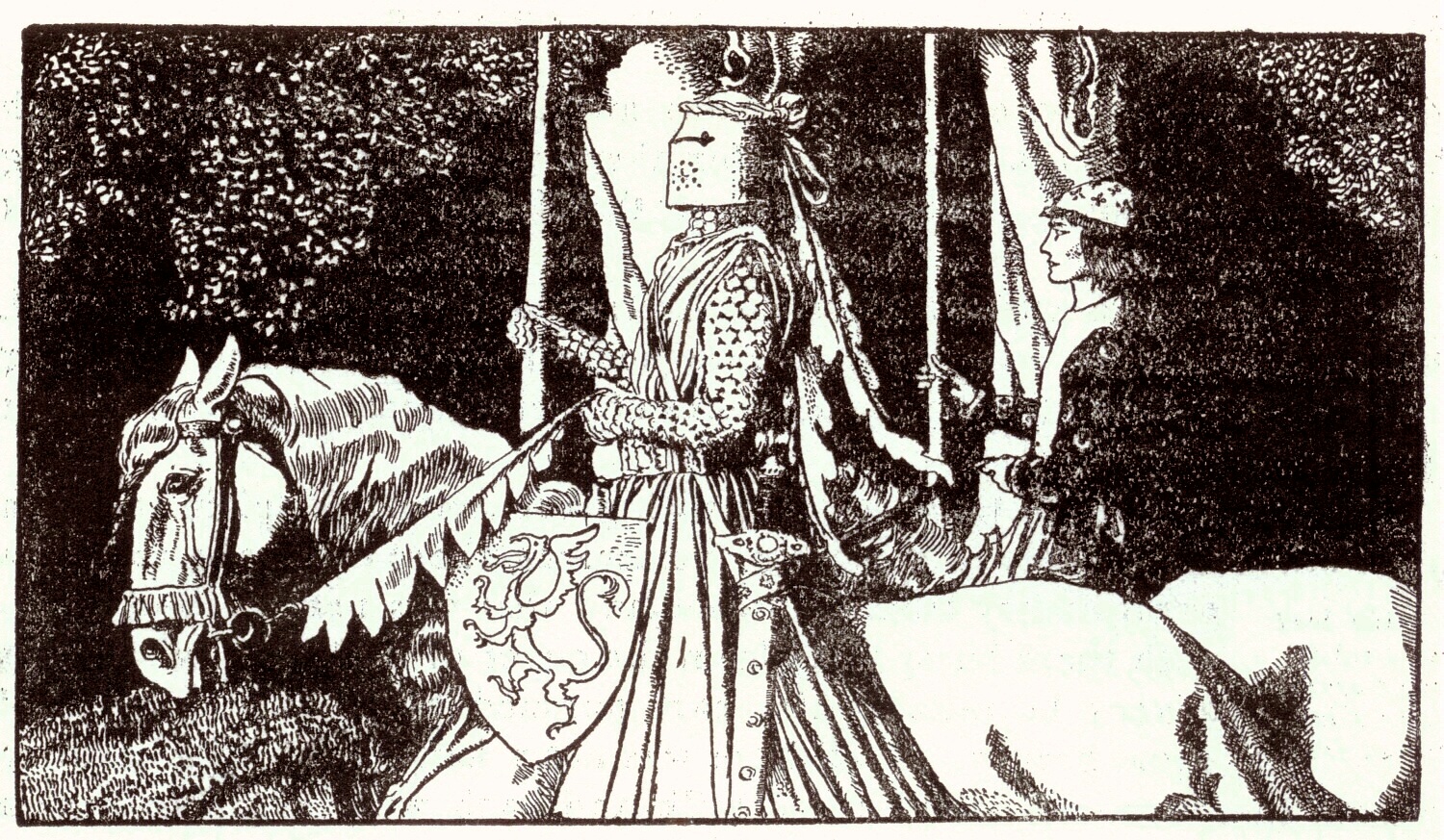
Galahad by Edwin Austin Abbey (Un-textbook)

Thursday, October 30, 2014

Storytelling for Week 11: The Questing Beast

The Questing Beast

“Awaken, king, and behold the symbol of your destruction.”

Arthur groaned as his eyes endeavored to open, the shrieking cries of the dying and the tearing claws of beasts still fresh in his mind. Lifting his head from the cold bark of the tree he reclined against, he ran a sweaty hand across his face and looked up.

A pair of serpentine eyes as large as Arthur’s head hovered close before him. Jerking back, the king instinctively reached for the sword laying at his side, but found himself unable to bring it to bear. Looking down, Arthur saw that the creature in front of him had pinned the blade to the ground with the large hoof that extended from one of the beast’s lion-like forelegs.

“You have no need to fear me, Arthur Pendragon,” the beast said, his scaly mouth revealing glistening fangs as he spoke the words in an icy tone. “I have not come here to bring harm to you.”

Arthur stared at the beast for a moment, his hand seeming to move of its own accord as it released its grip on the sword hilt.

A low chuckle rumbled from the throat of the beast as it slid away from the king, its lithe leopard’s frame gracefully strutting toward the nearby spring. One eye still focused on Arthur, the beast dipped its reptilian head down toward the spring and began to lap up the water with a large forked tongue.

Arthur slowly got to his feet, his eyes studying the beast, the likes of which he had never seen before. “What is your name, creature?”

“I am many things,” the beast replied, lifting its head from the water. “Vengeance. Lust. And chaos. Things with which you are quite familiar.”

“I know these things, but have endeavored not to be entrapped in them,” Arthur said.

The beast swung its head to fully face Arthur once again. “Yet you are a man. Flawed. Full of vices that you have no hope to suppress. Prone to creating Chimeras like myself—cursed beasts who are fated only to bring destruction.”

“I do not understand what you mean,” Arthur said, confused.

“Not yet, but some day you will,” the beast said. “For now, I will tell you a story.”

The creature settled down onto the ground by the spring, its long neck nestling next to one of its muscular haunches. “There was once a princess who was the most beautiful in all the world. Knights from all over the land sought her hand, and many a lance was tilted for even the honor of being granted an audience with the fair maiden. Yet this princess refused to marry all the suitors no matter how worthy they might be. Her heart, you see, was set on one man--her own brother. Eldagan was his name, and he was a famed knight in these lands in decades past. In her lust for Sir Eldagan, the princess formed a contract with a demon, agreeing to spend one night with the fell creature in exchange for making her brother return the feelings she had for him.”

Arthur shivered at the thought of a person going to such lengths for the sake of fulfilling such a corrupt lust.

“In the end the treacherous demon betrayed the princess and orchestrated events to where Sir Eldagan became accused of raping his sister. One of the finest knights of his era met his demise not on the battlefield in glorious combat, but at the hand of his own father, who set his dogs upon his unjustly accused son.”

The beast lifted his head from the ground and fixed Arthur with a stare that was filled with a deep melancholy.

“I am that princess’s cursed offspring, a living testament to the evils man is capable of,” the beast said in a regretful tone. “It was I who slew my mother and the rest of her unfortunate family.”

Arthur shook his and looked away from the tragic creature’s mournful gaze. “I did not wish to know any of this. Why must you tell me these things?”

“A wise king must know of folly if he is expected to not fall victim to it himself,” the creature said. “You have already sinned, Arthur, and your sin will bear fruit that will bring about your destruction in good time, as it did with my poor mother. I give you this warning, and urge you to be a righteous king who will not repeat the mistakes of the past. The chaos that will engulf your kingdom is inevitable, but if you rule with a wise and virtuous hand, then many years of prosperousness still await your kingdom and your people.”

Arthur nodded. “I would rule no other way than that, creature, regardless of what you advise.”

The beast rose up to his feet and bobbed his head in a nod. “Remember me, king. Remember my story. For one day you will know it to be yours.”


Author’s Note: This story is based on “The Questing Beast” in the King Arthur unit. I read up on what the Questing Beast was all about on Wikipedia and decided to write a story that detailed the Questing Beast’s creation and how it can be seen as being symbolic of Arthur’s sin of sleeping with his half-sister Morgause and birthing Mordred, who becomes the agent of his own destruction. I wanted to portray the Questing Beast as being an intelligent and somewhat tragic creature who desires to pass on what it has learned through its own creation to Arthur.

Picture of Arthur and the Questing Beast (Un-textbook)

Bibliography Information:
Book: King Arthur: Tales of the Round Table
Author: Andrew Lang
Year Published: 1902

Web Source: Un-textbook


Monday, October 27, 2014

Week 11 Reading Diary: King Arthur

Even though I've taken an entire class on Arthurian myth before, I can never get enough of the world of King Arthur and his knights, so I couldn't resist picking this unit. Just reading through the first half I was treated to some cool stories. You have the well-known stories that many people are familiar with in "The Drawing of the Sword" and "The Sword Excalibur," but there's also some less familiar ones as well. I found "The Questing Beast" interesting since it features a knight associated with a certain spring, a story element that is also present in Chrétien de Troyes's "The Knight with the Lion," which I read in my Arthurian class. This is a good example of how certain story elements in one Arthurian myth had a tendency to be duplicated in other stories within the genre. 

"The Passing of Merlin" was one of my favorite stories in the first half since it's a tale with which I'm less familiar. It's kind of hard to believe how even the wisest of men in Merlin can get taken in by amorous feelings to the point that he submits himself fully to such feelings knowing that they will be his downfall. It's a sad story, but a good portrayal of how emotions can render even the most wise and knowledgeable of people unable to do act in a rational way. 

"King Arthur and Morgan Le Fay" was a tale which I was mostly familiar, but the last part of the story in which Arthur forces his own adviser to put on the mantle he received from Morgan was new to me. I found this story a little shocking since Arthur isn't usually portrayed as being so harsh and demanding in the stories I've read (he's either a perfect warrior king or a sleepy ruler whose past his prime in the tales I've covered). I felt bad for the Lady of the Lake who gets burned alive due to Arthur's uncompromising demand for her to basically test the safety of the garment for him. 

The stories in the second half that encompass the quest for the Holy Grail are even more compelling than the first half stories. I really liked how characters are given their own story arcs that interweave and come together in a manner similar to what you see in modern novels. In particular I liked the arc of Lancelot. The tale of Lancelot's affair with Guinevere is pretty well known, as is the tragic manner in which it ends, but I like how Lancelot's grail quest emphasizes the heavy toll Lancelot's adultery has taken on his own soul. You really get the feeling in stories like "Sir Lancelot's Vision" and "Sir Lancelot and the Five Hundred Knights" that Lancelot is a man weighed down by guilt and regret. His character stands in sharp contrast to that of Galahad, who is portrayed in every story to be the ideal knight. Coming from my modern perspective that likes flawed, heavily conflicted characters, I found Lancelot's character to be the more compelling of the two. 

One of the most intriguing stories to me of this entire unit was "Sir Galahad and the Grail." What made this story so unique to me was how the three grail knights are portrayed in the story. The way they heal a crippled man and then are summarily persecuted by the king of Sarras immediately calls to mind the works and trials of the apostles. While many Arthurian stories portray extremely devout and righteous knights, this is the first narrative I read where it seems like the three men have transcended the role of mere knights and become apostle-like figures.

Sorry, Gawain, you can only be the perfect knight in so many stories before you're arbitrarily labeled as more sinful than Lancelot and sent back to Camelot grail-less
(1903 Illustration of Gawain by Howard Pyle from The Story of King Arthur and his Knights from Wikipedia)


Week 10 Famous Last Words

Agh, my back! That's pretty much been the theme for this previous weekend. Ever since my Thursday morning commute to Norman for classes my lower back has been aching a lot. My Capstone basically has me bent over a book the entire period listening to the professor lecture, so my back was complaining particularly loudly during that time. It was off and on at first, but now it's present and not going away. I must have injured it some way or another, but I don't really know how. All I know is that it is making it extremely hard to concentrate fully on getting my assignments done for this class.

The goods news is that the semester has slowed down since midterm time and now pretty much the rest of the semester has me doing smaller assignment for my two online classes while working steadily on longer-term projects that will be due at the end of the semester for my other two classes. In other words I have a ton more flexibility in my schedule and won't have to worry about being pressured by papers until near the end of this semester. Consoled by this fact, I pretty much took it easy this weekend, but my ailing back has prevented it from being as relaxing a weekend as it could have been. At this rate I'm probably going to have to take some pain medicine just so I can sit through my classes tomorrow without squirming in pain.

It looks like we're heading toward the European mythology unit next, which has me excited since I've been looking forward to reading some more Arthurian stuff. The last two storytelling weeks I've felt a bit starved for inspiration, so I'm hoping that delving into one of my favorite mythological worlds will properly stoke the fires of my imagination and allow me to write something really good for Wednesday.

Penguins! (Wikipedia Commons)

Friday, October 24, 2014

Week 10 Essay: Magic and the Supernatural in the British North American Unit

Magic and the Supernatural in the British North American Unit

There is a good amount of supernatural things going on in many of the stories in the British North American unit. While not necessarily dominant themes in the unit, it is common in the stories for there to be characters that have some kind of ability to do supernatural things. In these tales many people can shape shift at a whim, inanimate objects can talk, and even ordinary people are capable of supernatural things under the right circumstances.

The Making of Lakes andMountains” is a good example of acts of magic that seem almost accidental. In the story a woman flees from some bears that have captured her, and along the way throws various things onto the ground. In this story hair oil becomes a lake, pieces of a whetstone becomes mountains, and even hair combings become a mass of trees. Although seemingly a normal woman, this protagonist is capable of achieving miraculous things with use of the most mundane of objects. It’s notable that at the beginning of the story, it says that “[the woman] wanted to escape, and she remembered to do as she was told.” The passage then goes on to describe how, after she combed her hair, she gathered her combings together, then got some hair oil, a whetstone, and some red ochre before setting out. Now I wasn’t exactly sure what to make of this “she did as she was told” statement at first, but it seems to me that the woman had been told by some other person at some point how to properly escape from a dangerous situation. Thus her use of objects like the hair oil came from faith in a person’s advice. Thus this story can be seen as a way of validating that, when we are danger, we should look to the wisdom that has handed down to us by others. Because the woman in this story did this, she was not only able to escape, but also perform great feats that literally transformed the landscape of the world. Even the small things we do can have big effects this story seems to be saying.

The most obvious supernatural element that stands out in “Wolverene and Rock” is the fact that a rock and a wolverine can both talk in this story. Anthropomorphism of even inanimate objects is common in Native American tales from what I’ve observed, and so this isn’t a particularly unique supernatural story element, but it’s still worth noting. The other supernatural element in this story is the arrival of Thunder and Lightning. Thunder and Lightning is not only portrayed as being an individual with his own agency, but also Wolverene’s brother. The world in these stories is one where every aspect of nature is sentient, and on some level related. This is a great illustration of the Native American world view, which holds to the idea that everything in nature is related and has some kind of effect—whether direct or indirect—on every other element in nature.

The characters in the story who possess magical abilities that they actively use in the story are normally tricksters like Coyote. In “Coyote and Fox,” we see two tricksters pitted against each other who use their magic to gain the upper hand against the other. For example, in retaliation for eating his food, Coyote uses magic to create fire to burn Fox, but Fox in turn counters by setting back the fire with his powers. Later, after Coyote has stolen Fox’s robe of silver-fox skins, Fox summons a wind to blow the garment off of Coyote and back to its original owner. In most Native American stories I’ve read Tricksters are ascribed supernatural abilities such as these, perhaps in order to give them less limitations in their ability to trick others. In any case the use of magic certainly makes the stories more compelling and surprising.

The world showed in the stories of this unit is one where the limitations we normally place on nature are surpassed. Magic and the supernatural is a matter of course in most of the narratives. Tricksters use it at their whim, and even “normal” individuals like the woman in the first story I discussed do magical things. Rocks, wolverines, and thunder and lightning are anthropomorphized and even made to be related, and in this way the view that all of nature is related is expressed. As w hole the stories in this unit are not only rich and entertaining, but very thematic and clever in the way the supernatural is portrayed.

Silver fox (Un-textbook)

Thursday, October 23, 2014

Storytelling for Week 10: How Jake Lost a Race to Rock and Cicadas

How Jake Lost a Race to Rock and Cicadas

Jake had to walk uphill to his high school every weekday and he hated everything about it. Every day the sun beat down on him and had him sweating halfway up the climb. His book-laden backpack hung heavy on his shoulders and pressed his sweaty T-shirt against his clammy backside. The worn soles of his tennis shoes evinced the toll the daily trek had taken on his feet, which were always sore every time he reached the hilltop.
Then there were the cicadas. Every day the cicadas sang their morning song, and Jake’s teeth ground together in annoyance with every monotonous note.
One day after school Jake was standing at the hilltop preparing to descend when he saw a cicada sitting upon a boulder. Jake raised his foot high in preparation to stomp it, but the cicada flew off before  Jake could kill it.
“Stupid cicadas,” Jake muttered as he made to head downhill.
“The cicadas don’t like you either, jerk,” a voice said, the low, gravelly tone coming from the direction of the boulder.
Jake glared at the boulder. “Who asked your opinion, stupid Rock!?
“Nobody ever asks us rocks’ opinion, but that doesn’t mean we don’t have things worth saying, youngster," Rock said.
“Sure, sure,” Jake said snidely, stooping down to poke at Rock.
“I’ve been on this hilltop for decades,” Rock said. “I have seen more in my long life than you will ever see, and know more stories than you will likely ever know.”
“Yeah, so what?” Jake said, poking Rock again.
“So . . .” Rock began, a hint of impatience now tinging his voice, “the sum of a person’s wisdom can be determined by the number of stories he knows, for what are stories but microcosms of experience that teach us about the nature of life and the good and bad ways it can be lived?”
“I don’t know what you just said, but it sounds stupid, Rock” Jake said.
Rock sighed heavily. “Then why don’t we create a story of our own?”
Jake stared at Rock, arching a brow. “How?”
“A race, my angsty friend,” Rock said.
“A race? With who?”
“With me of course. Whoever reaches the bottom of the hill first wins.
Jake laughed. “Are you forgetting that you’re a rock, Rock?”
“We rocks can be quite speedy in the right context.”
Jake stood up and crossed his arms. “You just want me to get all sweaty running downhill, don’t you?”
“There’s no stopping this story now that I’ve decided to start it,” Rock said. “Whether you choose to run or walk, I’m going to win this race.”
Jake shook his head incredulously and began to jog downhill. He did not want to look silly by sprinting down the hill, but there was something in Rock’s tone that made him feel that it might be smarter to jog.
When Jake was halfway down the hill he looked back up the incline and saw that Rock had still not moved. Gritting his teeth in anger for being fooled by the boulder, Jake decided to walk the rest of the way down the hill.
Jake had not even taken three steps when he felt a rumble beneath his feet. Looking uphill again, he saw that Rock was rolling down at incredible speed. Yelping in surprise, Jake began to dash downhill, worn soles slapping hard against the grass as he sought to reach the bottom before the boulder could catch up.
The rumble grew louder until Jake could hear it over his own ragged gasps and the thunderous beats of his heart. He willed his feet to go faster, but there was no outpacing the rolling Rock. Rock surged in front of Jake and hurtled toward the foot of the hill.
When Jake reached the bottom, Rock was still rolling for a long time before finally settling several feet away. Panting Jake trudged over to where Rock now sat.
“H—how did you?” Jake said, breathless.
“It only takes a little bit of a push to get a rock sitting on the edge of a hill rolling,” Rock said.
“But . . . but—”
“But nobody was there to push me?” Rock interrupted. “What about those much hated cicadas of yours? You may deem them your enemies, but having been on this hill a long time, they have become my longtime friends and companions. Rather than growing to hate their song, I have come to appreciate the beauty of its nuances, and through it their people as a whole. It was them who gave me the push I needed to secure victory.”
Jake shook his head. “You're lying.”
“Believe what you will, young one,” Rock said, “but whether you acknowledge it or not, this is the day a man lost a footrace to a rock and cicadas. My sitting here at the foot of the hill will be a testament to this story long after you are gone.”
Jake went away and tried to forget the events of that particular day, but every day he went up and down the hill to school he couldn’t help but look at Rock and remember that race that he had lost. So too could he not listen to the cicada song and feel the same way he used to about it. Although the sound still grated on his nerves, he began to feel an odd appreciation for it. Perhaps this was the wisdom Rock spoke of, a wisdom gained through being part of a story.

Author's Note: This is based on the story in the British North American unit entitled "Wolverene and Rock." In the original Wolverene teases a rock about the fact that he cannot move, but the Rock states that he is capable of rolling. The mischievous Wolverene starts to race downhill and Rock rolls after him and eventually catches up and shmooshes him. Woverene calls for help to his brother Thunder and Lightning and Rock ends up blasted into a million pieces while the wolverine gets his fur coat torn to pieces. In my version I kept the central idea of a character racing Rock downhill, but gave it a modern context and replaced Wolverene with a rambunctious teenager named Jake. The cicada thing was a random idea that came about since I thought the setting of the story should be a hot spring day, which for whatever reason made me think of cicadas. The story ended up being quite different from the source material, and I thought it was fun to explore some different themes from the original.
A rolling stone gathers no moss . . .  and is pretty handy in a downhill race besides (Wikipedia, picture taken by Kate Ter Haar, 2010)


Bibliography Information
Book: Myths and Legends of British North America
Author: Katharine Berry Judson
Year Published: 1917
Web Source: Un-textbook


Wednesday, October 22, 2014

Week 10 Reading Diary: British North American Unit

So I did the half-reading for the British North American Unit, and overall liked it pretty well. There's a good blend of different types of stories in this unit, from trickster stories to creation stories to ones that combine elements of both. Animal and human characters both feature pretty heavily in these stories, and I found it interesting how many of the stories associate a certain aspect of nature with tribal organization. For example, in "The Origin of the Chinook Wind" there are the Cold People and the People of the Heat. In "The Coming of the Salmon" there are Salmon People, which are divided into many different tribes, as well as Berry People. As with most other Native American stories I've read, there's a definite feeling of a fluid barrier that exists between different species. A person can be a salmon in one instance and a human the next. Even the inanimate things of nature, such as rocks, are capable of speech and, to a limited extent, movement.

My favorite stories were "Wolverine and the Geese," "Big Turtle," and, most of all, "Coyote and Fox." All three of these tales feature great tricksters. Although I typically associate wolverines with dumb, brute force, the wolverine of "Wolverine and the Geese" is actually pretty cunning in how he uses a song to distract his prey from his malicious intentions. This story is also used to explain why the loon's eyes are red by showing that it was the angry curse of Wolverine that initiated this transformation. While it seems like kind of a random thing to add in, it appears that trickster stories quite often contain cosmological themes. The other great thing about this story is how the trickster ultimately becomes the fool. Although Wolverine has things his way in the first part of the story, it's ultimately Jay who gets the last laugh.

Sorry, Wolverine, you can't always have it your way (Un-textbook)

I like "Big Turtle" mainly because I just enjoyed how Turtle uses reverse psychology to win the day. It's amusing to see how Turtle toys with Eagle's friends, telling them that he enjoys being placed in a fire and then proclaiming his horror at their threat to throw him into the water. The line "Oh, no! I am afraid of the water!" had me chuckling quite a bit.

"Coyote and Fox" is an awesome story since it pits two classic trickster characters against each other. It's fun to see how Fox trolls Coyote and how Coyote struggles to get him back. I considered Coyote to be kind of the king of tricksters, so I was surprised to find that Fox has the upper hand throughout pretty much all of the story.

Monday, October 20, 2014

Week 9 Famous Last Words

So my last Famous Last Words ended with me wanting to curl up and weep right? Well, things turned out for the better when I found out one of my papers that I thought was due last Thursday was changed to where it was due Tuesday instead. This left me more time to study for the mid-term I took Wednesday, so as a result I think I did fairly well, although the test was harder than I thought it would be. I still had to rush Friday to get the majority of the paper proposal and annotated bibliography done before I left for Latham Springs, Texas for a College age Christian Conference that would leave me pretty much without internet access from Friday evening until Sunday evening. Still I got it done, and was able to enjoy my weekend without having to worry about school at all. Thank you, Lord!

The conference I was at was great. I've been to around ten of them since I first started college and have never regretted going. Every conference  has benefited me spiritually, and you get to spend a lot of time with your fellow club members, not to mention see and meet members from the Christians on Campus clubs in universities all over the Midwest area and sometimes beyond. It’s a really rich and enjoyable experience. I’ll post a youtube video that shows a little bit of what it’s like for those who might be curious:


Video is from College-Conference.org (there's me in green with the goofy grin at :26!)

I feel pretty tired from having such a busy weekend, and I’ve still got a paper that I have to get written today, but I’ve been writing so much over the years I have spent in college that it’s come to the point that the prospect of writing a paper in less than a day no longer intimidates me. Onward I go!

Penguins! (Wikipedia Commons)

Friday, October 17, 2014

Week 9 Essay: Moralizing Aspect of Eskimo Folk Tales

Moralizing Aspect of Eskimo Folk Tales

I only read the second half of stories from this unit, so I cannot speak to all of the Eskimo stories available on the Un-textbook, but from what I did read I saw that many of the narratives concern themselves with teaching a lesson of some sort. The first three stories of the second half are especially strong in this regard, while the others are a bit less overt. There is a definite feeling when reading these stories that they were or have descended from orally passed down narratives told in order to pass on wisdom and certain values. 

Some of the characters in these stories act in extreme ways and do things that I could not imagine any average person doing. Pâtussorssuaq in the story of the same name abruptly kills his own kin after the man hears that his uncle and his uncle's wife plan to go on a hunting journey. After slaying his uncle Pâtussorssuaq's aunt flees and the protagonist heads to his own tent to kill his wife, "for he was already weary of her." He's foiled by the fact that his wife has already fled, but by this time the story has clearly established Pâtussorssuaq as a negative character who is acting disproportionately greedy and murderous. Yet oddly Pâtussorssuaq ends up getting what he wants and living with his late uncle's wife. However, she dies quite quickly and thus "had little joy of the woman he had won by misdeed." Pâtussorssuaq's later death at the hands of his uncle's spirit indicates that, while those who murder and cheat to get their way may profit for a short time, their ultimately destined to meet an untimely end.

It is interesting to note that both in this story and in "Papik, Who Killed HisBrother's Wife," that it is not the actions of humans that ultimately brings in justice, but the actions of the supernatural, or perhaps more precisely the supernatural acting in the form of nature. Pâtussorssuaq first loses the object of his affection to the natural force of death, and then loses his own life to his uncle's ghost, which takes the form of a bear. Papik similarly is killed by a spirit that has assumed a bear's form. These stories portray nature to be somewhat of a judge, jury, and executioner capable of taking care of those who would act immorally. 

Human justice has its day in some of the other works though. "The Eagle and the Whale" features the pair of brothers of some women who have had the misfortune of being paired up with an eagle and whale respectively. These stories indicate that these pairing are unnatural, and there is a need for human interference in order to restore things to the normality. At the same time these narratives could be seen as cautionary tales to women of marriageable age who have resisted getting married.While this may seem weird to the sensibility of modern women, it probably made sense within a culture where women could not be expected to live easy lives if they did not marry since they would inevitably need husbands who could provide them with food and other necessities. Even in such a whimsical tale, there seems to be an underlying message that is indicative of the values in Eskimo culture. Even the short tale "Kánagssuaq" conveys important lessons about kindness and reciprocity. The way Kánagssuaq helps his fellow hunter Kilitêraq and is later repaid in kind with a walrus hide and a bearskin is a beautiful depiction of mutual reciprocity, a value I've noticed is quite central in many Native American cultures. 

The stories the Eskimo Folk Tales are not, in my mind, very strong in the way of characterization or story, with the exception of a few. They are, however, effective moralizing and value-conveying tales that would have been useful for teaching and aiding the enculturation process for Eskimo youths. Characters do not always act reasonably in the stories, but this is because they are not meant to be realistic so much they are meant to serve as mechanisms to teach proper and improper behavior and the consequences associated with each.

Inuit seal-skin home/tupiq (Un-textbook)

Thursday, October 16, 2014

Storytelling for Week 9: The Seal-Boy

The Seal-Boy

The seal-boy we called him.

We first saw him just off the coast of the land we were heading towards. Clad in the mottled skin of a seal, he plunged into the water and did not rise up for a long time. Fearing the boy had drowned, we paddled to the place where he fell, but as soon as we got there, the boy suddenly emerged from the water in front of my kayak.

An impish grin lit up the boy’s smooth face, and his dark eyes danced with pleasure at the bit of mischief he had played on us.
“He’s over here!” I called from my position at the rear of the kayak fleet. Looking at the young rogue’s face, I couldn’t help but chuckle, and for the moment I forgot the unpleasant task that awaited our group when we came ashore.
Suddenly the boy dove back beneath the water. The rest of the kayaks paddled around the area with amused looks on their faces as they again sought the boy out. The little one emerged out of the water several times amidst the kayaks, naughtily shaking our crafts just hard enough to cause some to grow angry with the troublemaker.
Later the boy emerged much further away from our fleet. He waved at us cheerfully.
We gave the boy chase. Further and further the seal-boy swam, his little head dunking beneath the water and emerging a long distance away from his last location. The irregular cadence of paddling oars and shouts followed him as we made to catch up with the boy, but he ever kept his distance as he brought us out to open sea.
The boy finally stopped next to an iceberg that had run aground. The boy leaped clear of the water and clambered up the gleaming white surface of the iceberg, reaching the top with astonishing ease.
The seal-boy stood atop the iceberg and leaned against a large piece of loose ice that lay precariously close to the edge. We paddled over to the iceberg and looked up, gazing upon the seal-boy’s jeering face.
“We cannot climb it as he did, but if we were to carve steps into the side, we could reach him,” one of the kayaks suggested.
We thought this a sound idea, and several of the kayaks took out knives and picks and began to chip at the base of the iceberg. The workers labored steadily under the seal-boy’s stoic scrutiny until they managed to carve out steps leading directly to the iceberg’s peak.
Kayaks began to climb the iceberg, their sealskin moccasins treading cautiously upon the slick steps. The ascending kayaks still clutched their tools firmly in their hands, but I knew they would be put into an entirely different use once they reached the seal-boy.
The seal-boy casually strode away from the climbers and disappeared behind the large piece of ice he had been leaning against. Suddenly the chunk slid closer to the edge, its trajectory angling towards the kayaks’ climbing path. It took only that little shove to cause the piece of ice to slide down off the top of the iceberg and tumble down its side. The kayaks screamed in terror and dismay, but there was nothing they could as the ice struck them one after another and sent them hurtling into the icy waters below.
Angry shouts tore from the throats of the other kayaks. Before any of them could react, the seal-boy leaped from the top of the iceberg. The boy dove toward the water headfirst, hands outstretched before him to break through the water first before the rest of his body plunged beneath.
A long tense moment passed as we waited for the boy to emerge again. Instead, we heard a terrified scream as one of the kayak’s vessel was overturned. My breathing quickened and my head panned every which way as I watched another kayak have his paddle stripped from him before his own boat was forcibly cap-sized. Other kayaks were taken by surprise from behind as the seal-boy lunged from the water, seized them, and then dragged them beneath.
The dreadful reality of what would happen to me if I did not run finally sunk in as I saw limp forms begin to rise to the surface of the water. My body seemed to move of itself as I sought to turn my vessel around and paddle as far away from the iceberg as I could.
I was making steady progress when the horrifying sound of splashing water came from behind me and I felt a forceful tug on one end of my paddle. Frightened and certain of my death, the paddle slipped from my limp, shaky hands. A whimper rose up from my throat as I desperately began to paddle my kayak with my hands. I shivered as my palms pushed through the freezing water, but my shaking was not because of the cold. I knew my time had come.
I looked at the stick that lay beside me in my boat: my only weapon. Against the likes of this merciless boy who swam so easily in the water I knew such a weapon would prove inadequate.
To my surprise, one end of my paddle suddenly reappeared and came to rest in my lap. I looked to my right and found that the seal-boy was holding the paddle out to me.
“You I will not kill,” the boy said. “I will allow you to go home, but you must tell your people never to come here seeking to kill us. If they do not heed this warning, then I will kill them all, and not let a single one return.”
I looked upon the deadly serious face of the youth as I wordlessly took back my paddle. I knew that I would do as he said, and that I would never return to this place again, for I had no wish to run across the seal-boy ever again. 

Author's Note: This is based on Âtârssuaq from the Eskimo Folk Tales unit. In the original story, we learn about the birth and maturity of the son of Âtârssuaq, who from a very young age is trained by his father to be an extremely skilled swimmer. Âtârssuaq is eventually killed by his enemies, and the son finds himself tasked with having to defend his people from an invasion of northerners coming down in a fleet of kayaks. Using his skilled swimming abilities, he lures his enemies out to open sea and to an iceberg, then begins to kill them through various means. In the end he only spares one helpless kayak, and sends him home with a warning. So pretty much this story follows the second half of the original plot line to the letter, but it is is written from the perspective of the lone survivor. I wanted to create a slight feeling of terror for this so-called seal boy and show his brutality from the viewpoint of someone who nearly found himself being dragged to a watery grave at the youth's hand. This story is a little on the rushed side, so I hope you still enjoyed it for what it is.
Inuit family (Un-textbook)
Bibliography Information
Title: Eskimo Folk-Tales
Author: Knud Rasmussen
Year Published: 1921
Source: Un-textbook

Tuesday, October 14, 2014

Week 9 Reading Diary: Eskimo Folk Tales

I read the second half of the Eskimo Folk Tales unit this time. In general I found this unit to be a bit drier than the ones I've read before. There's really only a few characters from the stories I read that stood out as memorable to me. Many of the stories in the unit seem to be more focused on teaching moral lessons than supplying compelling character stories.

"Papik, Who Killed His Wife's Brother", "Pâtussorssuaq, Who Killed His Uncle", and "The Wife Who Lied" are good examples of the stories focused around teaching moral lessons through showing the harsh consequences of murder and deceit. The characters here seem less important than the lessons taught in the narratives, and this is probably why I didn't much care for these first three stories of the second half of the unit. 

Things get better with some of the later stories though. Although I have trouble comprehending some of the events that occur in "The Eagle and the Whale" (how in the world does a whale up and sweep away a girl on land?) and the characters in the story still lack compelling attributes, at the very least the tale is a fun adventure yarn. "Atdlarneq, the Great Glutton" is a very weird story in which the main characters wins the day by the strength of his bottomless pit of a stomach. The concept of an Eskimo bogey man named Copper-Cheeks sound interesting, although I feel like there could be stories that make better use of this interesting character.

"Âtârssuaq" was my favorite story of the bunch, because it was the first tale I read that featured a character with interesting traits and who even has a bit of a story arc. His training with his father helps establish the son's skills and sets up his triumph in putting those skills to use to defend his own life and those of his people. I also like how the son is a formidable trickster, while at the same time being a merciful hero who is willing to spare the life of the last of the enemy force. A lot of the characters in these stories are pretty darn brutal (the father in Ángángŭjuk who threatens to kill his wife for allowing their son to run off comes to mind), so the protagonist in this story was a bit of a breath of fresh air. 

If that's what a benign Eskimo spirit look like, then I don't want to imagine what the bad ones look like (Un-textbook)

Sunday, October 12, 2014

Week 8: Famous Last Words

So this week has been the calm before the storm that will be my week 9. My weekend was awesome but woefully unproductive considering how much I've got on my plate for this new week. On Friday I played basketball with my friends at the nearly empty Huff and then ate out at Louie's with a few of them. I watched the game at a friend's house the next day. I took naps and laid idly on the couch often. I  I barely did anything that resembled work, and for that I feel myself becoming rapidly regretful. 

Here's my laundry list for the week: I’ve got my work for this class and my usual reading for my capstone. I've got a midterm in my Sports Management class Wednesday that I have yet to study for. I have a paper over a historical fiction book called Fire and Beulah due on Thursday that I have not started.  I haven't even so much as picked out which prompt I want to address from the list I was given! I have a research paper proposal and annotated bibliography due a week from today and I haven't even decided what my research topic is yet. There's an upcoming Christians on Campus trip to a camp in Texas next weekend that will ensure that I have no access to the internet from Friday afternoon all the way until Sunday evening, so last minute research is out, meaning I'll have to find a way to figure out a topic and gather sources between cram and paper-writing sessions. Oh yeah, and I've got a quiz on Thursday over two-hundred pages worth of reading from a book I don't even have yet. 

These are the moments that define a person, right? Right? Excuse me while I curl up in the fetal position on my bed. 

Wednesday, October 8, 2014

Week 8 Reading Diary

Reading through my past diaries, I would say that I did a decent job of not making all of them a collection of dry summaries. I feel like all my diaries have at least a little bit of my opinions or some analysis in them. I do think that I could stand to be more analytical in future diary posts. That way the diaries would be more helpful when I'm writing the essay later in the week. I've also done more half readings than I've wanted to in this first half of the class, and I hope that I can do more full readings in the second half.

My posts vary somewhat in length since some are half-reading diaries and some are full reading diaries, but I feel like in either case the posts are of a good length. I also like to include pictures in my diaries since they help call to mind the stories that I read in that unit. I have only included quotes sparingly, but I may start to do that more in future posts. I occasionally make connections to other works I've read, but again I think I could do this more. 

I find reading less enjoyable when I take notes while doing it, so I prefer to write down my thoughts after having completed the reading. When I look at the notes I took in the diaries, I've found them useful in helping me to remember the basic content and themes of the past units I read. While I don't tend to consult my diaries when I write my essays, some of the things I note in the posts end in my essays. I feel like because the readings I choose are interesting, I tend to remember many of the stories even without having to look at past notes I've taken, which is often more than I can say for the readings I've had in other classes. In general I think the reading diaries are a good strategy to help people to better remember what they have read. I feel like the storytelling and essay assignment also have a similarly positive effect on people's remembrance and comprehension of their past readings.

Monday, October 6, 2014

Week 7: Famous Last Words

So I missed Storytelling this week (or rather last week, because I'm also writing this Famous Last Words way late), which is especially bizarre for me since I really love to write and Storytelling is my favorite aspect of this awesome class. Things just really piled up on me since I had a lot of reading to do for a class and had an essay due in my Capstone that was really stressing me out.

Just to go into a little detail about that essay: The assignment was to write a 5-7 page paper over a poem in the Norton Anthology of Poetry (5th edition). I picked a random Wordsworth poem and went with it. Now keep in mind that I didn't choose to become an English major out of any particular love for poetry. I actually don't like poetry that much. I prefer meaning to be more concrete and easy to see, as it is in prose (not so much the case with the language of Faulkner, Woolf, or Joyce, but even their works are easier to analyze than a lot of poetry to me). Believe it or not, I've made it through most of college having had to write very few essays about poetry. As a result, I found the task of writing a poetry analysis essay to be one of the most difficult writing assignments I've had in a long time. I think the main thing that bothers me about writing over poetry is that I'm never confident that what I'm writing is actually a good argument. Digging out evidence for an argument in a book is easy to me, and I'm always sure that my argument makes sense and never doubt the logic of my premise. With poetry it's different, because in some cases I'm having to look at a single word or phrase and pull a much more subjective idea out of it in order to validate my argument. Evidence that has a greater subjective element to it innately feels more flimsy to me, and as a result I find that when I use such evidence I begin to doubt my argument as whole. This is a terrible feeling to me, and it's why I found writing this essay to be a less than pleasant experience.

Nevertheless, I got through it. Now I've got the 10-12 page poetry analysis coming up to worry about. Yay!

Back to the subject of missing Week 7 Storytelling, one of the main reasons I'm really sad that I missed it is that I actually had a story idea ironed out already. Since I have time this week, I plan to follow through with it and write the story despite the fact that I won't get any points for it.

Penguins! (Wikipedia Commons)

ST

Friday, October 3, 2014

Week 7 Essay: Tricksters and Fools in Japanese Fairy Tales

As with the Georgian folktales that I discussed in a previous essay, the Japanese fairy tales are full of heroes who overcome trials and foes not by the strength of their arms, but by the sharpness of their wits. Trickster characters abound in these stories, ranging from the young boy in “Schippeitaro” to the crab in “The Crab and the Monkey” to the various tanuki that feature prominently in several of the tales. With tricksters come fools as well, and it is interesting to note that many tricksters in these stories in up being made into fools in the end. This reversal of roles is what of makes many of these stories so delightful to read.

Despite being entitled “Schippeitaro,” the hero of the story is in fact the nameless protagonist who harnesses the might of the canine Schippeitaro to solve a local feline problem. Although the hero of the story goes on a journey to do great deeds and is described as fighting duels with other men who have set out with a similar mindset, it is notable that protagonist ultimately achieves victory in this story through trickery rather than brute force. When the protagonist first hears of the problem a village has of having to sacrifice its maidens to a Local Mountain Spirit, he investigates with pointed questions that ultimately lead him toward a way to solve the problem. It is impressive how quickly the hero draws a connection between the spirit and the dancing cats he encountered the previous night in the chapel where the young girls are apparently ritually offered up. From there he is able to piece together in phrase he overheard—“Do not tell Schippeitaro”—with the information he has and determine that this Schippeitaro is the key to his overcoming the Mountain Spirit. He is then able to hatch a plan to use Schippeitaro the dog to ambush the spirit and kill it. Ultimately the hero in this story prevails because of his potent inductive reasoning skills and his cleverness in laying a trap. He is a trickster with a bit of a Holmesian twist one could say.

The Crab and the Monkey” is interesting in how the trickster protagonist Crab succeeds in tricking the fool Monkey multiple times, but does not always win out in every exchange. At the beginning of the story Monkey offers to trade his half-eaten kaki fruit to Crab for her handful of rice, thinking he will get the better end of the deal. The Crab makes the trade knowing that it can use the fruit’s seed to plant a tree that she can make her own. She succeeds in doing this later, and thus outwits the Monkey at first. Unfortunately he returns later and, seeing Crab’s beautiful kaki, asks if he can climb up in it and grab a few fruits for himself. Crab assents, but Monkey clambers up in her tree and begins to eat everything in sight. Once again resorting to trickery, Crab challenges Monkey to do some acrobatics on her tree, which he does, knocking some fruits down that Crab proceeds to snatch for herself. Noticing that he has been tricked, Monkey swings down and beats up Crab before she can secure a second batch of kakis for her burrow. Brute force wins over trickery in this second exchange, but in the end trickery prevails when Crab gets together with wasp, egg, and rice mortar (forget anthropomorphized animals, talking cooking implements are where it’s at in Japanese fairy tales!) and hatches a plot to trick Monkey one final time. In the end, Monkey dies from a rice mortar to the head (ironic considering that Crab’s relationship began over Monkey’s desire for some cooked rice, eh?) and wit once again proves superior to muscle.

The Slaying of the Tanuki” is a good example of a story that does not have a character with a set trickster or fool role. At first the peasant protagonist is the trickster when he lays a trap for a thieving tanuki and subsequently captures him. The tanuki then has in turn as he tricks the peasant’s wife into loosening his bonds and then frees itself, kills the wife, and feeds her to the peasant. The hare then comes into his own as a trickster as he tricks the tanuki, scorching him with flames and offering stinging salve for his wounds. Finally, the hare and peasant join forces and trick the tanuki to his death. What makes this story so interesting is how dynamically the roles of trickster and fool shift.

These Japanese fairy tales bring a lot of unique elements to the trickster narrative. “Schippeitaro” focuses on a hero who is able to piece together knowledge and use it form a plan to overcome a mountain spirit. “The Crab and the Monkey” features a multi-trick narrative in which cunning must pit itself repeatedly against brute force as the two creatures seek to get what they want from the other. “The Slaying of the Tanuki” also features many tricks throughout the story, but notably has different characters function in the role of fool and trickster. The variety of ways in which the trickster narrative is used in these tales makes them all very enjoyable to read.

Dat wasp tho! (Un-textbook)


Wednesday, October 1, 2014

Week 7 Reading Diary: Japanese Fairy Tales

This sign pretty much sums up the tanuki stories
in this unit: Mind the tanuki!
(Wikipedia Commons)

Once again I did a half-reading for this week, and since I liked the Japanese mythology unit that I read last week, I decided to go through the second half of the Japanese fairy tales. These were all really good reads, with all of them emphasizing animal characters of varying moral inclination. I liked how a lot of these stories emphasize animal-human partnerships, like the young man and the dog Schippeitaro, the peasant and the hare, and Uraschimataro and the turtle.

"Schippeitaro" was a nice coming-of-age type story about a young man who has set out to become a man by gaining fame through accomplishing great deeds. He veritably stumbles across the opportunity to do so when he finds himself stuck in a chapel where some fierce cats come along to party. I thought it was pretty remarkable how the boy is able to utilize a phrase that he overhears at that time--"Do not tell Schippeitaro"-- to such great advantage later. The protagonist's most impressive trait in this story isn't his physical strength, but his cleverness in making the connection between the ritual sacrifice of a maiden to the chapel he stayed in and the cats he encountered who appear to so fear this Schippeitaro. The dog himself plays a very minor role in the story compared to the other animal partners that are featured in this unit, but it was still pretty cool to see how the canine cleverly cooperates with the protagonist's scheme of hiding him in a basket until the time of attack.

Three of the stories in the second half focus on the tanuki. I found it interesting how the tanuki's morality is highly variable from story to story. In some ways the tanuki reminds me of the Native American trickster animal Coyote. As with the coyote, the tanuki may do good or evil, but its defining point is its unpredictability and chaotic tendencies. The tanuki in "The Magic Kettle" is at first a troublemaker, but once Jimmu makes the effort to communicate with it, they come to an understanding and the trickster's powers are able to be harnessed to positive effect. The next stories, however, show another, darker side of the tanuki. These stories show that mere mischief has the capacity to escalate to outright evil. When such evils occur, the perpetrator must be punished. In true ironic fashion, the evil tanuki in "How the Wicked Tanuki Was Punished" and "The Slaying of the Tanuki." meets his end through trickery.

On a side note, what's with the fixation on people being tricked into unintentionally eating their loved ones in mythology? This is the second time I've encountered it now, with the first being in the Khasi folktale "The Leap of Ka Likai." It's disturbing.

Umm... that's  not like any tanuki I've seen pictures of. (Un-textbook)
That's more like it! (Wikipedia)