Showing posts with label Reading Diary. Show all posts

Monday, November 3, 2014

Week 12 Reading Diary: Welsh Fairy Book Unit (Thomas)

So I did a full reading of the Welsh Fairy Book unit by W. Jenkyn Thomas and pretty much got what I expected: Many somewhat strange but thoroughly entertaining stories featuring names and places that I have a hard time remembering by nature of Welsh’s unique letter combinations (“Rhad Duw ar y da” for instance). Since there is no one protagonist to follow throughout all twenty-one of the stories in this unit, I found myself forgetting a lot of the characters that I read about, but I don’t get the feeling that the actors in the narratives are really so much important as the plot. The most enjoyable thing about these stories to me is the magical world that is created in them. In the world of Thomas’s book, fairies and magic are very real and very much in contact with the everyday, mundane world of shepherds and farmers. This makes for some very neat and compelling tales about the interaction between the worlds of the natural and the supernatural.
The first story in the unit—“Arthur in the Cave”—is among the most memorable since it deals with the legacy of King Arthur and the Round Table. This story presents a different fate for Arthur since it places the Once and Future King not in Avalon, but in a underground cave in Wales. In addition, Arthur is portrayed as being the future savior of Wales who will at the appointed time arise from his subterranean sleep and, together with the rest of his knights, take back Britain for the Welsh. It’s intriguing to see how the Welsh took the story of King Arthur and made it their own, transforming the British mythological icon into a messianic figure for Wales.
Einion and the Lady of Greenwood” was among my favorite of the stories in this unit. It features the protagonist Einion, who falls under the spell of a goblin trickster known as the Lady of the Greenwood. This story was fun since when you think things are going Einion’s way as he is freed from the goblin’s charm, a twist comes in when the Lady decides to take the form of a handsome nobleman and casts the same love spell over Einion’s own wife. Fortunately Einion manages to win the day and win his wife back even as he exposes the goblin’s true nature.
March’s Ears” was one of the most out there tales in the unit. The whole concept of a king having a horse’s ears and somehow managing to keep it concealed from everyone but his barber is pretty weird in itself, but the series of events that leads to the creation of a pipe that, when played, exposes the monarch’s secret marks this story as bizarre in the most hilarious sense of the word. Thomas definitely takes to a somewhat odd style in this story as well. I can safely say that this is the first fairy tale I’ve read in which a character refers to his neck with the scientific term cervical vertebrae.
The theme of normal people benefiting from faeries is recurring throughout several of the stories in the unit, including “The Stray Cow” (although the beneficiary in this story ultimately ends up the worse by the end of the story because he had the misfortune of looking a fairy cow in the mouth so to speak), “The Fairy Reward,” (again the main character doesn’t end up better off by the conclusion since fairies aren’t very beneficent once their beneficence becomes known to too many people), “The Bride from the Red Lake” (another unhappy ending, this one seemingly arbitrary:  Are fairies allergic to clay or something?), “Einion and the Fair Family” (actually has a happy ending too!), and “Dick the Fiddler’s Money” (which teaches us that playing a mean fiddle can really pay off at times).
My favorite story in the unit was “The Men of Ardudwy.” This story is absolutely epic in how it focuses on the fiercely fought battle between the Men of Vale and the Men of Ardudwy, who have made off with the maidens of Vale since Ardudwy has been suffering from a shortage of women of late. Many of the stories in this unit focus on how a certain geographical location came to be, or how it came to called a specific name, but among these types of stories this one stood out to me since the lake that comes to be called Llyn y Morwynion—the Maidens’ Lake—has such a memorable and tragic story behind it. The language in the story is also quite lovely at times, with the description of the women of Vale jumping to their deaths being particularly poignant and evocative:
“When the last of the men of Ardudwy fell, and the desperate fight was done, they plunged into the waters red with the blood of their lovers and kindred, like some great flight of white birds sweeping down from a wave-washed cliff down to the sea. The still waters leapt in foam: one loud shriek woke the air, and then silence reigned over all.”
The Martyred Hound” is also a good story, but as you might expect from a tale titled as such, it’s a pretty sad narrative. I’d recommend not reading it if you’re in a depressed mood.
The Battle of Llyn y Morwynion (Un-textbook)

Monday, October 27, 2014

Week 11 Reading Diary: King Arthur

Even though I've taken an entire class on Arthurian myth before, I can never get enough of the world of King Arthur and his knights, so I couldn't resist picking this unit. Just reading through the first half I was treated to some cool stories. You have the well-known stories that many people are familiar with in "The Drawing of the Sword" and "The Sword Excalibur," but there's also some less familiar ones as well. I found "The Questing Beast" interesting since it features a knight associated with a certain spring, a story element that is also present in Chrétien de Troyes's "The Knight with the Lion," which I read in my Arthurian class. This is a good example of how certain story elements in one Arthurian myth had a tendency to be duplicated in other stories within the genre. 

"The Passing of Merlin" was one of my favorite stories in the first half since it's a tale with which I'm less familiar. It's kind of hard to believe how even the wisest of men in Merlin can get taken in by amorous feelings to the point that he submits himself fully to such feelings knowing that they will be his downfall. It's a sad story, but a good portrayal of how emotions can render even the most wise and knowledgeable of people unable to do act in a rational way. 

"King Arthur and Morgan Le Fay" was a tale which I was mostly familiar, but the last part of the story in which Arthur forces his own adviser to put on the mantle he received from Morgan was new to me. I found this story a little shocking since Arthur isn't usually portrayed as being so harsh and demanding in the stories I've read (he's either a perfect warrior king or a sleepy ruler whose past his prime in the tales I've covered). I felt bad for the Lady of the Lake who gets burned alive due to Arthur's uncompromising demand for her to basically test the safety of the garment for him. 

The stories in the second half that encompass the quest for the Holy Grail are even more compelling than the first half stories. I really liked how characters are given their own story arcs that interweave and come together in a manner similar to what you see in modern novels. In particular I liked the arc of Lancelot. The tale of Lancelot's affair with Guinevere is pretty well known, as is the tragic manner in which it ends, but I like how Lancelot's grail quest emphasizes the heavy toll Lancelot's adultery has taken on his own soul. You really get the feeling in stories like "Sir Lancelot's Vision" and "Sir Lancelot and the Five Hundred Knights" that Lancelot is a man weighed down by guilt and regret. His character stands in sharp contrast to that of Galahad, who is portrayed in every story to be the ideal knight. Coming from my modern perspective that likes flawed, heavily conflicted characters, I found Lancelot's character to be the more compelling of the two. 

One of the most intriguing stories to me of this entire unit was "Sir Galahad and the Grail." What made this story so unique to me was how the three grail knights are portrayed in the story. The way they heal a crippled man and then are summarily persecuted by the king of Sarras immediately calls to mind the works and trials of the apostles. While many Arthurian stories portray extremely devout and righteous knights, this is the first narrative I read where it seems like the three men have transcended the role of mere knights and become apostle-like figures.

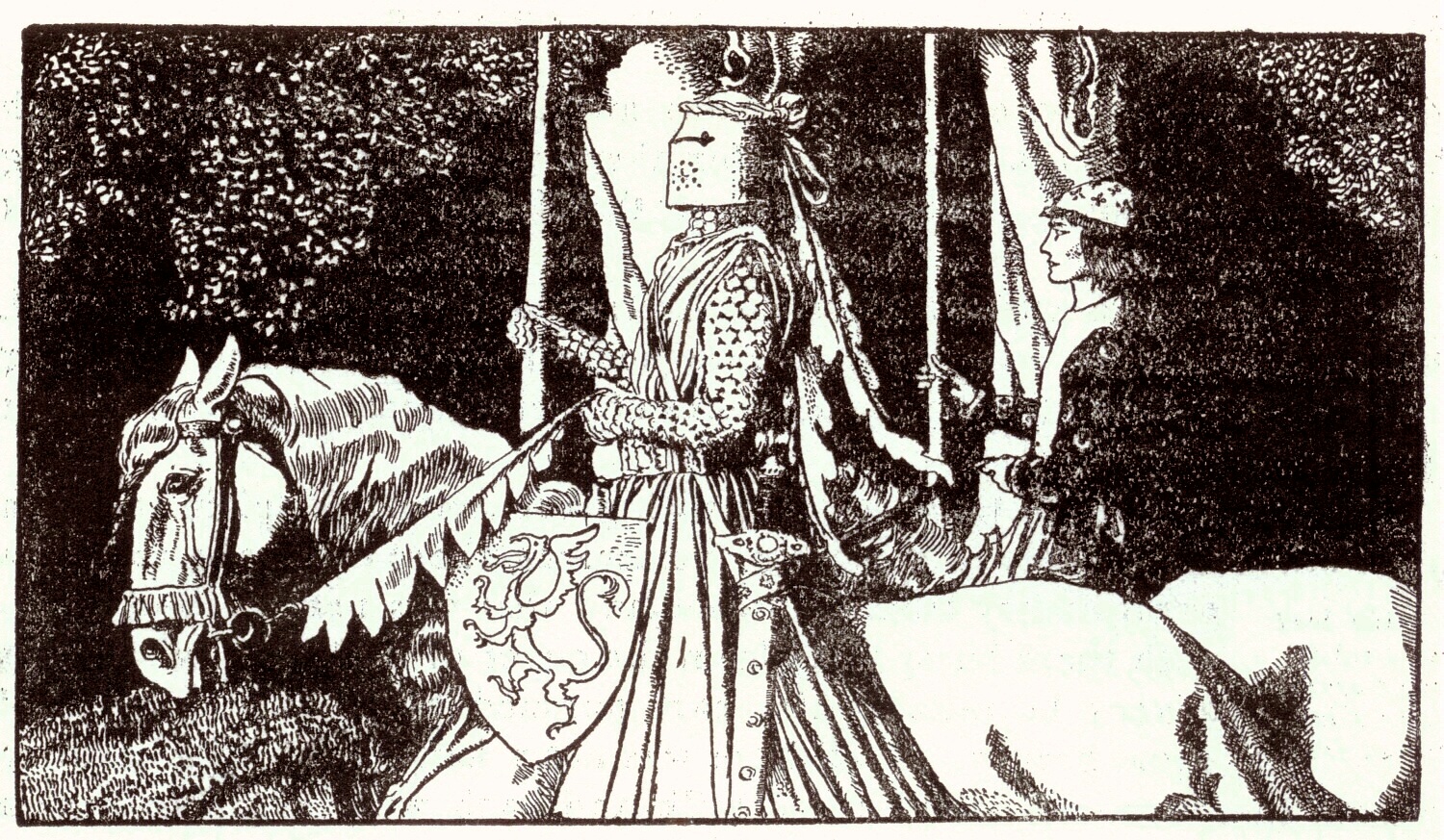
Sorry, Gawain, you can only be the perfect knight in so many stories before you're arbitrarily labeled as more sinful than Lancelot and sent back to Camelot grail-less
(1903 Illustration of Gawain by Howard Pyle from The Story of King Arthur and his Knights from Wikipedia)


Wednesday, October 22, 2014

Week 10 Reading Diary: British North American Unit

So I did the half-reading for the British North American Unit, and overall liked it pretty well. There's a good blend of different types of stories in this unit, from trickster stories to creation stories to ones that combine elements of both. Animal and human characters both feature pretty heavily in these stories, and I found it interesting how many of the stories associate a certain aspect of nature with tribal organization. For example, in "The Origin of the Chinook Wind" there are the Cold People and the People of the Heat. In "The Coming of the Salmon" there are Salmon People, which are divided into many different tribes, as well as Berry People. As with most other Native American stories I've read, there's a definite feeling of a fluid barrier that exists between different species. A person can be a salmon in one instance and a human the next. Even the inanimate things of nature, such as rocks, are capable of speech and, to a limited extent, movement.

My favorite stories were "Wolverine and the Geese," "Big Turtle," and, most of all, "Coyote and Fox." All three of these tales feature great tricksters. Although I typically associate wolverines with dumb, brute force, the wolverine of "Wolverine and the Geese" is actually pretty cunning in how he uses a song to distract his prey from his malicious intentions. This story is also used to explain why the loon's eyes are red by showing that it was the angry curse of Wolverine that initiated this transformation. While it seems like kind of a random thing to add in, it appears that trickster stories quite often contain cosmological themes. The other great thing about this story is how the trickster ultimately becomes the fool. Although Wolverine has things his way in the first part of the story, it's ultimately Jay who gets the last laugh.

Sorry, Wolverine, you can't always have it your way (Un-textbook)

I like "Big Turtle" mainly because I just enjoyed how Turtle uses reverse psychology to win the day. It's amusing to see how Turtle toys with Eagle's friends, telling them that he enjoys being placed in a fire and then proclaiming his horror at their threat to throw him into the water. The line "Oh, no! I am afraid of the water!" had me chuckling quite a bit.

"Coyote and Fox" is an awesome story since it pits two classic trickster characters against each other. It's fun to see how Fox trolls Coyote and how Coyote struggles to get him back. I considered Coyote to be kind of the king of tricksters, so I was surprised to find that Fox has the upper hand throughout pretty much all of the story.

Tuesday, October 14, 2014

Week 9 Reading Diary: Eskimo Folk Tales

I read the second half of the Eskimo Folk Tales unit this time. In general I found this unit to be a bit drier than the ones I've read before. There's really only a few characters from the stories I read that stood out as memorable to me. Many of the stories in the unit seem to be more focused on teaching moral lessons than supplying compelling character stories.

"Papik, Who Killed His Wife's Brother", "Pâtussorssuaq, Who Killed His Uncle", and "The Wife Who Lied" are good examples of the stories focused around teaching moral lessons through showing the harsh consequences of murder and deceit. The characters here seem less important than the lessons taught in the narratives, and this is probably why I didn't much care for these first three stories of the second half of the unit. 

Things get better with some of the later stories though. Although I have trouble comprehending some of the events that occur in "The Eagle and the Whale" (how in the world does a whale up and sweep away a girl on land?) and the characters in the story still lack compelling attributes, at the very least the tale is a fun adventure yarn. "Atdlarneq, the Great Glutton" is a very weird story in which the main characters wins the day by the strength of his bottomless pit of a stomach. The concept of an Eskimo bogey man named Copper-Cheeks sound interesting, although I feel like there could be stories that make better use of this interesting character.

"Âtârssuaq" was my favorite story of the bunch, because it was the first tale I read that featured a character with interesting traits and who even has a bit of a story arc. His training with his father helps establish the son's skills and sets up his triumph in putting those skills to use to defend his own life and those of his people. I also like how the son is a formidable trickster, while at the same time being a merciful hero who is willing to spare the life of the last of the enemy force. A lot of the characters in these stories are pretty darn brutal (the father in Ángángŭjuk who threatens to kill his wife for allowing their son to run off comes to mind), so the protagonist in this story was a bit of a breath of fresh air. 

If that's what a benign Eskimo spirit look like, then I don't want to imagine what the bad ones look like (Un-textbook)

Wednesday, October 8, 2014

Week 8 Reading Diary

Reading through my past diaries, I would say that I did a decent job of not making all of them a collection of dry summaries. I feel like all my diaries have at least a little bit of my opinions or some analysis in them. I do think that I could stand to be more analytical in future diary posts. That way the diaries would be more helpful when I'm writing the essay later in the week. I've also done more half readings than I've wanted to in this first half of the class, and I hope that I can do more full readings in the second half.

My posts vary somewhat in length since some are half-reading diaries and some are full reading diaries, but I feel like in either case the posts are of a good length. I also like to include pictures in my diaries since they help call to mind the stories that I read in that unit. I have only included quotes sparingly, but I may start to do that more in future posts. I occasionally make connections to other works I've read, but again I think I could do this more. 

I find reading less enjoyable when I take notes while doing it, so I prefer to write down my thoughts after having completed the reading. When I look at the notes I took in the diaries, I've found them useful in helping me to remember the basic content and themes of the past units I read. While I don't tend to consult my diaries when I write my essays, some of the things I note in the posts end in my essays. I feel like because the readings I choose are interesting, I tend to remember many of the stories even without having to look at past notes I've taken, which is often more than I can say for the readings I've had in other classes. In general I think the reading diaries are a good strategy to help people to better remember what they have read. I feel like the storytelling and essay assignment also have a similarly positive effect on people's remembrance and comprehension of their past readings.

Wednesday, October 1, 2014

Week 7 Reading Diary: Japanese Fairy Tales

This sign pretty much sums up the tanuki stories
in this unit: Mind the tanuki!
(Wikipedia Commons)

Once again I did a half-reading for this week, and since I liked the Japanese mythology unit that I read last week, I decided to go through the second half of the Japanese fairy tales. These were all really good reads, with all of them emphasizing animal characters of varying moral inclination. I liked how a lot of these stories emphasize animal-human partnerships, like the young man and the dog Schippeitaro, the peasant and the hare, and Uraschimataro and the turtle.

"Schippeitaro" was a nice coming-of-age type story about a young man who has set out to become a man by gaining fame through accomplishing great deeds. He veritably stumbles across the opportunity to do so when he finds himself stuck in a chapel where some fierce cats come along to party. I thought it was pretty remarkable how the boy is able to utilize a phrase that he overhears at that time--"Do not tell Schippeitaro"-- to such great advantage later. The protagonist's most impressive trait in this story isn't his physical strength, but his cleverness in making the connection between the ritual sacrifice of a maiden to the chapel he stayed in and the cats he encountered who appear to so fear this Schippeitaro. The dog himself plays a very minor role in the story compared to the other animal partners that are featured in this unit, but it was still pretty cool to see how the canine cleverly cooperates with the protagonist's scheme of hiding him in a basket until the time of attack.

Three of the stories in the second half focus on the tanuki. I found it interesting how the tanuki's morality is highly variable from story to story. In some ways the tanuki reminds me of the Native American trickster animal Coyote. As with the coyote, the tanuki may do good or evil, but its defining point is its unpredictability and chaotic tendencies. The tanuki in "The Magic Kettle" is at first a troublemaker, but once Jimmu makes the effort to communicate with it, they come to an understanding and the trickster's powers are able to be harnessed to positive effect. The next stories, however, show another, darker side of the tanuki. These stories show that mere mischief has the capacity to escalate to outright evil. When such evils occur, the perpetrator must be punished. In true ironic fashion, the evil tanuki in "How the Wicked Tanuki Was Punished" and "The Slaying of the Tanuki." meets his end through trickery.

On a side note, what's with the fixation on people being tricked into unintentionally eating their loved ones in mythology? This is the second time I've encountered it now, with the first being in the Khasi folktale "The Leap of Ka Likai." It's disturbing.

Umm... that's  not like any tanuki I've seen pictures of. (Un-textbook)
That's more like it! (Wikipedia)

Wednesday, September 24, 2014

Week 6 Reading Diary: Japanese Mythology Unit

I did the half-reading for the Japanese mythology unit, and it was such a fun and adventure-filled read that I wished I could have found the time to do read the whole thing. Going through the second half of the unit, I read about the labors of the heroic warrior Yamato, the campaign of the Empress Jingu, and the unusual life of the fisherman Urashima, among other stories. The main thing that stuck out to me about this unit was the preponderance of strong female characters. I would have expected Japanese myths to be fairly male-dominated, but these stories proved otherwise. From the devoted Tacibana to the dangerous siren Benten to the warrior empress Jingu, these stories are thickly populated by formidable women with strong agency.

All of the labors of Yamato were great reads, but my favorite among them was the labor involving his climactic battle with Susa-no-wo the dragon-god. Ironically, it wasn't the battle itself that made this my favorite, but rather the scene prior to the fight. The prose in the Yamato tales is consistently good throughout, but I really liked the way the author describes Tacibana's rescue of Yamato from Benten's clutches. This is a triumphant moment in the story when Yamato finally comes to realize Tacibana's worth. The scene speaks quite well for itself:
Then dim and far, above the endless leagues of jade-green water, Yamato was ware of the Princess Tacibana gently murmuring his name. Through the infinite depths he beheld her lovesome face smiling to him from out the dusky cloud-rifts of her hair. 
Then knew Yamato that “the goddess more beautiful than Benten whose love was greater than her own,” was none other than his faithful Tacibana. 
Downward, like the tendrils of some miraculous vine, grew the dusky tresses of Tacibana. They enveloped Yamato in a fragrant cloud and enlaced him in the meshes of a silken net. Like strong encircling arms they upbore him, through endless leagues of water, to the sea-swept isle of Enoshima.
The two stories centering on Empress Jingu and Prime Minister Takeuchi were also very enjoyable to go through. While I would not exactly recommend "The Jewel of Heart's Desire" to any of my Korean-born friends, it's a neat a tale about Japanese conquest guided by the strong hand of Empress Jingu. Jingu is a great character whose likeable in her strength and occasional impetuousness. The way she tests the gods by asking for them to show her certain signs, like girding her with armor and weapons in preparation for her campaign after she dives into the ocean, was my favorite moment in the story.

Another quality female character shines through in the succeeding story, "The Quest of the Jewel." Tamatori, a peasant women who is in love with the Prime Minister, boldly plunges into the ocean and retrieves the stolen Jewel of Heart's Desire from the palace of Benten for the sake of her beloved. When surrounded by the servants of a sea-dragon, Tamatori kills herself and hides the jewel in her own lacerated body, knowing that the sea monsters will not attack a corpse. In this way, she brings the jewel back to a grateful Takeuchi. Although Takeuchi reaps the benefits of the courageous woman's labor and is declared emperor by Jingu, Tamatori shines forth as the true heroine of the story.

Tuesday, September 16, 2014

Reading Diary Week 5: Khasi Folktales

I did a half-reading for this week, and chose to focus on the second half of stories from the Khasi folktales. The tales I read were mostly origin stories involving various animals. The stories were interesting, although I didn't find them as much fun to read as the Georgian folktales.

"The Leap of Ka Likai" is a . . . disturbing cautionary tale against rashly rushing into remarriage. In the story, a woman--Ka Likai--ends up remarrying a cruel man out of a desperate desire to gain the support needed to keep her beloved daughter alive and well. The new husband ends up becoming jealous of his own step-daughter, and eventually kills the girl and proceeds to cook parts of her body, which he later feeds to his unknowing wife. This nasty and twisted story ends with Ka Likai throwing herself to her death down a waterfall, which from then on bears her name and serves as a reminder of the importance of considering carefully the matter of marrying again. Yeah, this was far from my favorite story, but it has taken the dubious honor of being the most unsettling tale I've read so far for the class.

"What Makes the Lightning" is a pretty neat story that explains the origin of lightning. It features a bunch of animals and assorted supernatural beings gathering together for a festival of dancing and music. A prideful lynx by the name of U Kui brings a silver sword to the party and entrances his audience with a graceful dance. A thunder giant  named U Pyrthat asks the lynx if he can borrow the sword and dance a while. Although U Kui refuses at first, he is shamed by the other animals giving over his sword. The giant takes the sword and proceeds to dance, beat on his drum, and then jump into the sky. The result is the first instance of lightning. From then on, the animals knew that thunder and lightning was the result of U Pyrthat dancing in and drumming in the sky while brandishing his stolen silver sword.

One of my favorites in this unit was "How the Cat Came to Live With Man." This story features a cat named Ka Meow . . .  er, rather Ka Miaw. Ka Miaw is a member of a royal household ruled by his brother the tiger. Ka Miaw is a cat who is very proud of her lofty heritage, but her brother unfortunately hordes all the best food and forces the cat into sneaking around at night and eating lowly things like mice and frogs. Ka Miaw is one day sent by her brother to the village of mankind, and it is here where she gets her first taste of being treated kindly. She plays with some human children for so long that she runs late with her errand ends up greatly offending her brother. When she returns to the tiger, the fiercesome feline threatens to beat her. Ka Miaw flees in fear back to the land of mankind, and from then on decides to live beside humans from then on.

"How the Tiger Got His Strength," might have been my most favorite story of this unit. I suppose this is because I like how there is an actual trickster character in this story in the form of the tiger. I liked how the story explains how the tiger became so strong, and how humans, so that they could counter the strength of beasts like the tiger, were blessed with the skill to create weapons that would allow them to oppose beings of greater strength than themselves. I think either this or the cat story would be fun to retell.

Epic lynx (Wikipedia Commons)
Photo taken by Tony Hisgett (2013)

Monday, September 8, 2014

Reading Diary Week 4: Georgian Folktales

This week I chose "Georgian Folktales" as my reading unit. This unit had a lot of very interesting stories. As with "The Voyages of Sindbad," the protagonists of these stories primarily deal with problems through the use of tricks. There are a lot of clever heroes, and nearly as many incredibly dumb antagonists, in the Georgian Folktales.

The first story I read was a very engaging yarn about a peasant's son who is apprenticed by a devil for a year at his father's behest. Although the devil tries to forever keep the boy with him, the boy ends up using the sorcerous powers he is taught in order to escape from his master's clutches. He then goes on to use his shape shifting abilities to help his poor father acquire some money. The highlight of this story, in my opinion, was the concluding scene in which, after having been captured by the devil once again, the boy plays an all too literal game of cat and mouse with his former master. Master and student participate in an elaborate chase sequence in which the both of them shape change into different forms of hunter and prey, until finally the boy turns into a needle and lures the devil into transforming into a thread going through his "eye," at which point the needle somehow runs into a nearby fire and burns the thread. This bizarre sequence was like nothing I'd read before, and it marked the story as one of my favorites in this particular unit.

"The Serpent and the Peasant" was an interesting read also. The main thing that stuck out to me with this story was how it ended, I was expected the peasant to get his just desserts for being such a treacherous--ahem--snake, but in the end he comes out of the story alive and well. Although he repeatedly betrays the snake that helps him, the serpent, surprisingly, never begrudges him. Rather, he lays the blame of the peasant's cruel actions on the shoulders of the world around him. I thought this was odd, as most of the fairy tales I've read tend to lay the full blame of a person's poor decisions on that person and that person alone. I also found it interesting that the serpent, a figure with negative associations within Christianity--with the exception of the bronze serpent--is a positive character in this story. I don't know much about the Orthodox Church, so I don't know if this was an Orthodox thing or a Georgian thing.

"The Cunning Old Man and the Demi" was one of my favorites as well. The old man's prowess as a trickster is exaggerated by the extremely unintelligent nature of the demon who he constantly tricks, but the story makes for a pleasurable read regardless. It's humorous to see the old man make a creature of such considerable power into basically his doting servant. A later story, "The Strong Man and the Dwarf," uses the exact same story formula almost to a tee, but for whatever reason, I found this story a bit more engaging than that one.

Rioni River, Georgia (Wikipedia Commons)

The second half of stories in this unit were not quite as good as the ones in the first half in my opinion, but there was still a few strong ones among the bunch. 

"The Grasshopper and the Ant" is what's called a cumulative tale, and features a grasshopper going on an increasingly complicated fetch quest to find the items necessary to eventually allow him to save a drowning ant (as in the insect, not the relative). Unfortunately he takes too much time and the ant ends up dying as a result. One of the story's central themes is that only the earth gives freely of itself. Everything else in nature only gives if it receives something in turn. Although a whimsical tale--at least up until the end--the story is a very effective expression of the idea of the reciprocal nature of nature.

"The Fool's Good Fortune" was also one of my favorites of this unit. This story does a good job of utilizing the main character's innate foolishness to create humorous situations. I laughed out loud when I read of the fool telling the monks at a monastery to "be fruitful and multiply" and then receiving a beating at their hands as a result! It's also a good underdog story, since the foolish main character manages to use his brain just enough to outwit some bandits, steal their fortune, and become rich. 

"The Story of the Dervish" is an entertaining narrative about a dervish whose spouse cheats on him and then turns him into a dog. It's a bizarre tales in which a princess whose being plagued by nightly "brownies"--someone please explain to me what the heck that means--is saved from mornings of fatigue and enfeeblement when the dog-protagonist drives away the flock of swans that somehow manage to sneak into her room each night and trample over her without actually waking her. Yeah, a flock of swans essentially attack her each night, and she somehow can't figure out what's giving her the brownies, whatever the heck those are. Despite being a bit of an odd duck of a story, the tale is still a lot of fun to read, with a nice ending in which the main character is able to regain human form and take revenge on his wife and her lover. All's well that ends well!

A dervish (not of the whirling variety) (Un-textbook)

Tuesday, September 2, 2014

Reading Diary Week 3: The Voyages of Sindbad

I accidentally read ahead and did a Middle Eastern unit for week 3 instead of another Biblical unit or a Classical unit, so bear in mind all Week 4 Sindbad readers that this way be spoilers. Although the Sindbad that I read about is far from being like Douglas Fairbank Jr.'s swashbuckling Sinbad, I can't say that I walked away disappointed after reading "The Voyages of Sindbad." Sindbad's character is very much in the vein of Odysseus, and this should come as no surprise given the apparent influence Homer's epic had on the stories of Sindbad. Sindbad has the bad luck of constantly running afoul of trouble on his many voyages, but as a trickster-type character, he utilizes his knack for using his wits to survive against the most unlikely of odds. Whether its gargantuan birds, giant snakes, hordes of elephant-eared cyclopses, or a society that forces men and women to be buried alive alongside their dead spouses, Sindbad rises to every challenge and finds a way to come out alive.

Some of Sindbad's voyages are better than others. I found the merchant's first and fifth adventures to be a bit on the dry side, but his other adventures are all very entertaining. The third voyage reads like a story straight from The Odyssey, but is still very enjoyable in its own right. The sixth and seventh voyages record Sindbad's transformation from an everyday--albeit absurdly rich--merchant into a respected diplomat for his city. 

Of all the voyages, my personal favorites were the second and fourth adventures. Sindbad's second voyage brings him in contact with a gigantic bird known as a roc. Hitching a ride on the bird, Sindbad finds himself in a valley full of diamonds. Unfortunately, there appears to be  no easy escape from the valley, and giant snakes--because everything in Sindbad's voyages has to be giant or it's just not fun--come out at night, forcing Sindbad to hide during that time. What really makes this story great is how Sindbad uses his knowledge and wit to escape from the valley with a load of diamonds. If there was one voyage that I would want people to read above the other voyages, it would be this one.

"Sindbad Children's Magazine" (Wikipedia Commons)
I found Sindbad's fourth voyage very interesting. Instead of having to deal with fearsome--and don't forget giant!--beasts, the sailor has to contend with the ridiculous laws of a society that he has found himself living in. According to the rules of this society, when a man's wife or a woman's husband dies, the living spouse is forced to be buried alive alongside her or him. Sindbad has the misfortune of getting married in this society, and as bad luck would have it, his wife dies. Sindbad ends up getting buried alive. This is when things take a turn for the dark. In what was to me quite a surprise, I read about Sindbad killing the living spouses that are lowered into the mass grave as they come so as to steal the bread and water that are ritually placed alongside the unfortunate man or woman. These are far from Sindbad's most heroic moments, and I was shocked at the rather casual tone with which he describes his murders. It actually inspired me to base my story tomorrow on this dark time in Sindbad's adventures. I think one could definitely mine a lot of pathos out of the scenes in the mass grave.

Tuesday, August 26, 2014

Reading Diary Week 2: Saints and Animals

I ended up doing a half-reading of the “Saints and Animals” section of the Biblical Unit. I read the second half of stories, which included a lot of really entertaining narratives about saints, animals, and the cooperative relationships that come to exist between them. I read of Saint Gudwall, who made a home for himself on a Welsh island thanks to the efforts of some helpful fish. I learned about Saint Athracta and the stags that she summoned to help her in a time of great need. I enjoyed the tale of Saint Gile, who risked his life for his Deer friend (terrible pun, I know!) and ended up converting a pagan king to the Christian faith. The tales of Saint Francis of Assisi were also very interesting. However, my two favorite stories among the second half of the unit were ‘The Wolf-Mother of Saint Ailbe” and "The Ballad of Saint Felix."

The Wolf-Mother of Saint Ailbe has a very interesting premise that I would not have expected from a saint story. I’ve heard stories of boys being raised by wolves before—the story of Romulus and Remus comes to mind—but I never would have thought that there was a saint’s legend that utilized the same concept. What I liked about the story is that it takes the time to establish the bond between Ailbe and his wolf family in the early part of the narrative. Ailbe’s treatment of the wolves comes off as truly heart-felt and genuine since the author uses the tragedy that occurs near the beginning of the story to deeply invest the audience in the saint’s relationship with the wolves. Ailbe doesn’t love the wolves just because he’s a loving guy, as with some of the other saints. He loves them because they are his family, and no barrier of species would ever allow him to deny his kinship to his wolf-mother and wolf-brothers.

It's kind of like this, only there's one less human and more wolves. And the human baby ends up getting kidnapped and becoming a bishop, who eventually reunites with his wolf family and from then on has dinner with them every night. The she-wolf in the Romulus and Remus story clearly got the short end of the stick compared to Ailbe's wolf-mother (Wikipedia Commons)
“The Ballad of Saint Felix” was a fun read for me because its main character is a bit different from the protagonists in the other stories. Felix is a bit more of a trickster. When he’s being hunted by soldiers, he dresses up as a pilgrim. When he runs afoul of his pursuers, he is able to calmly tell them that he has not seen himself pass by on the road, and thus avoids death for a short time. As with many of the other stories, Felix ultimately owes his life to the miraculous aid of an animal, in the case of this story, a spider with incredibly fast web-spinning skills. Felix is a resourceful man, but even he ultimately has to depend on the miracles of nature and the kindness of others in order to survive. Out of all the Saint and Animal stories I’ve read, I think this is the one where I could have the most fun writing a variation on for tomorrow. 

Saint Felix attacked and hidden by a spider's web (Wikipedia Commons)
As a whole, I found all of these tales very enjoyable. Not only do they have interesting stories, with engaging characters and conflicts, they all consistently espouse a theme about the importance of treating people and nature in a kindly way.